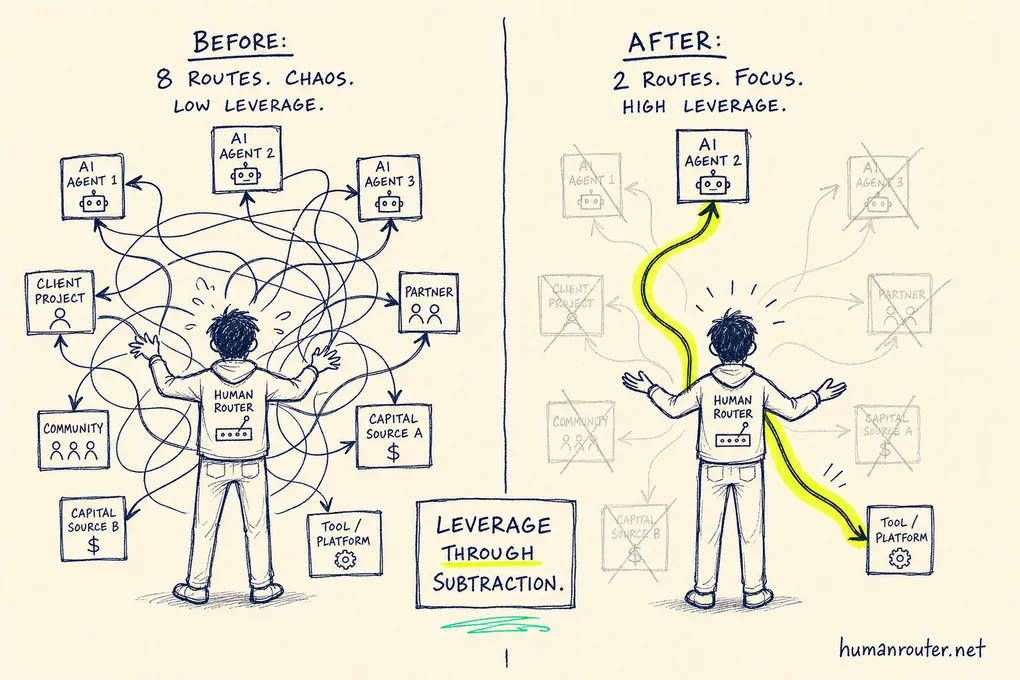
Leverage Is Subtraction
A few years into running Asian Efficiency, we had one of our best revenue years ever. Want to know what our entire growth strategy was that year?
Two things. A newsletter that went out twice a week and a live webinar once a week.
That’s it. No paid ads. No social media calendar. No launch funnels stacked on launch funnels. We ran about 80 webinars that year and kept the newsletter going like clockwork. The business grew more than in years where we were doing five times as many things.
I didn’t plan it as some genius strategy. We had limited people and limited hours, so we were forced to pick. And when we picked the two activities that actually produced customers, something surprising happened: they got better. The webinars got tighter because I was running them every single week. The newsletter got sharper because writing it twice a week builds a muscle you can’t build writing once a month. Repetition compounds. Variety doesn’t.
The instinct to add
Here’s what I see with almost every founder and operator I work with: when growth stalls, the instinct is to add. Add a channel. Add a funnel. Add a product. Add a tool.
Does this sound familiar? You’re doing eight marketing activities at 60% quality instead of two at 95%. For most of the eight, the honest answer is that you couldn’t tell me what they produced last quarter.
The math never works out. Eight things at 60% lose to two things at 95% every time, because customers don’t experience your average. They experience whichever touchpoint they hit. A mediocre touchpoint reads as a mediocre company.
Leverage is finding the two things that work and cutting everything else. Cutting is the leverage. The output you gain doesn’t come from the two things alone. It comes from all the attention that used to leak into the other six.
The same rule, applied to AI
I think about my AI spending the exact same way.
I spend about $1,200 a month on AI tools right now. But I stayed at $20 a month for years. My rule: upgrade only when you hit limits repeatedly. Hitting a paywall once means nothing. Hitting it every week means the tool is actually producing value. At that point the constraint costs you more than the upgrade.
Most people run this backwards. They subscribe to ten AI tools at $20 each, poke at each one occasionally, and cancel them all six months later convinced AI is overhyped. That’s the eight-channels-at-60% problem wearing a different shirt. One tool used daily, pushed until you hit its ceiling, will teach you more and produce more than ten tools you tour like a museum.
A rising AI bill on a shrinking tool list is one of the healthiest signals I know. It means you found your two things.
It works on people problems too
A concierge medical practice I advise got 50 website inquiries in two days. Sounds great, right? It nearly broke them. One person was spending 40 minutes on the phone with every lead. The ad-driven leads converted at a fraction of the rate of referrals.
The fix wasn’t hiring more people. We changed the first email to lead with pricing and their cash-only policy, upfront, no apology. About half the leads disappeared. The half that remained were worth the 40 minutes.
Same principle, third domain. Being selective about what deserves your personal attention is leverage. Your calendar, your inbox, and your lead flow all respond to subtraction faster than they respond to effort.
One thing to do this week
Write down every recurring activity you’re running to grow your business or your career. All of them, the podcast guesting, the three social platforms, the networking events you attend out of guilt.
Now find the two that produced actual results in the last 90 days. Real results you can point to: customers, revenue, offers, meaningful relationships. Not impressions.
Cut one of the others this week. Not pause. Cut. Then take the hours it frees up and put them into your top two.
You won’t miss it. Nobody will. And that’s the whole point.